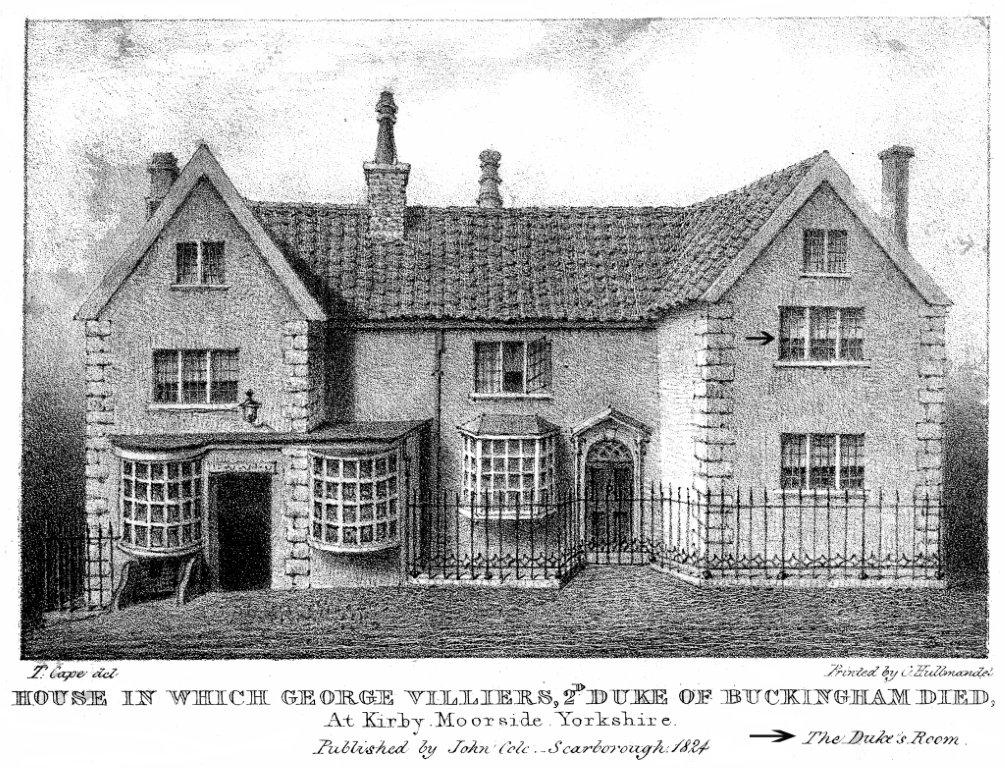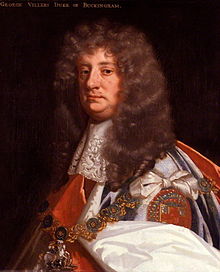
George Villiers, 2nd Duke of Buckingham was the son of George Villiers, 1st Duke of Buckingham and his wife Lady Katherine Manners, Baroness de Ros of Helmsley. He was born in 1628 and was only seven months old when he became the 2nd Duke following the assassination of his father. He was brought up in the royal household of King Charles I alongside the king’s own young sons the future Kings Charles II and James II.

When the Civil War broke out in 1642 Buckingham joined the king’s cause and fought with valour in the cavalry under Prince Rupert’s command. In 1648 he was made General of the Horse and fought at an engagement at Kingston-upon-Thames at which his brother Francis was killed. Buckingham managed to escape after a heroic stand against six Roundhead opponents with his back against an oak tree, which became a topic of Cavalier legend.
With the defeat of the Royalists, Buckingham fled abroad to exile in what is now Belgium along with Charles, Prince of Wales. All his lands were confiscated by the victorious Parliamentarians and his estate at Helmsley was given to their general, Thomas, Lord Fairfax who had successfully besieged and captured Helmsley Castle during the Civil War.
Amazingly, while Oliver Cromwell was ruling during the republican period of the Commonwealth, Buckingham returned to England and courted Mary, the only child of Lord Fairfax. She fell in love with him and they were married with her father’s full approval. This was a typically shrewd move on behalf of Buckingham because, if the exiled king was restored to the throne, his estates would be returned to him. However, if the monarchy was not restored, all George had to do was to wait patiently for the elderly Fairfax to die. Then, the estate would be inherited by Mary and pass legally to her husband. Whatever the political outcome, the duke would be guaranteed to return to his position at Helmsley Castle.

After the death of Oliver Cromwell the monarchy was restored and Buckingham went to Dover to personally greet King Charles II on his return from exile. At the coronation he carried the Sovereign’s Orb during the ceremony and was soon back at the centre of government as a member of the Privy Council. His confiscated estates were restored to him and he was said to be the king’s richest subject in the land.
His relationship with King Charles could also be turbulent and on one occasion he was imprisoned in the Tower for having cast the king’s horoscope, which was a treasonable offence. He was a prominent member of the Cabal Ministry, which was a group of five men who dominated the government of King Charles. Its name was derived from the initial letters of each of the men’s titles: Lords Clifford, Arlington, Buckingham, Ashley and Lauderdale. The word “cabal” has become an accepted part of the vocabulary of the English language and means a political clique or faction that can exercise power to the exclusion of others. In this way, one of Buckingham’s lasting legacies is that his name is commemorated as one of the letters of a word in the English language.
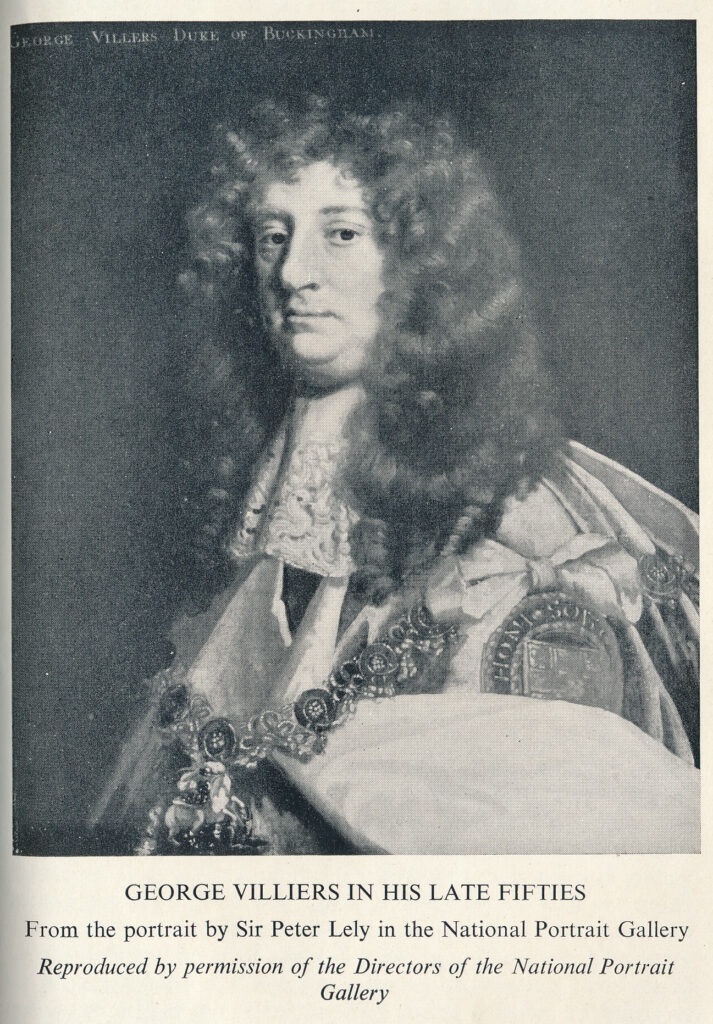
Having made many political enemies over the years, in 1674 both Houses of Parliament attacked Buckingham. The House of Lords complained about his continued, public affair with the Countess of Shrewsbury and he was forced to give security of £10,000 not to cohabit with her in future. The House of Commons, which resented his power, approved a petition to the king to remove him from office. King Charles had been waiting for an opportunity to do so as he was losing patience with him and quickly consented. When Charles’ brother succeeded to the throne as King James II, the new king had no personal allegiance to Buckingham and distanced himself from the duke. Buckingham took no part in public life after James’ accession and retired to his manor at Helmsley, probably because of poor health and exhausted finances.
On 14th April 1687, and now at the age of 59, Buckingham set off with the Bilsdale Hunt, of which he was the Master, from Helmsley Castle. After three hours vigorous riding, his horse dropped dead beneath him at Chop Gate, a small hamlet at the head of Bilsdale and twelve miles north of Helmsley. As no horse was available that was sufficiently strong to accommodate him, a groom was sent back to the castle to bring a fresh one. Buckingham, exhausted and very hot, threw off his coat and reclined on the damp grass for several hours before the groom returned with a new horse. He began to feel ill on the return journey and decided to spend the night in Kirkbymoorside in the best room of the best house of one of his tenants. He was putto bed with an aching fever and an inflamed stomach.
At the time, a distant cousin, Lord Arran, was in York and heard news of Buckingham’s condition. He immediately travelled to Kirkbymoorside to visit him and was shocked to see the condition he was in. On the second day, Arran suggested to the duke that he should “begin to think of another world, for it was impossible for him to continue in this”. However, he was adamant that “I am sure that I am in no danger of my life … and in a day or two I shall be well” and refused permission for anyone to call for a doctor or a priest. By the third day his condition had deteriorated to the point where he consented to summoning Dr Whaler from York and Rev Sheperd, the parish priest, of Kirkbymoorside. As the day progressed he agreed to receive the last sacraments of the Church of England as he slipped in and out of consciousness and died at eleven o’clock on the evening of 16th April.

After his death instructions were given that his body should be embalmed and that his heart and intestines should be buried at Helmsley. However, it seems that the latter instructions were not carried out because it is the parish register of All Saints’ Church that records Buckingham’s death as –
Gorges Vilaus, Lord Dooke of Bookingham
It is therefore likely that these mortal remains are buried in the churchyard at Kirkbymoorside.
For more than six weeks Buckingham’s body lay at Helmsley Castle before it began his last journey to London, the city that had seen his greatest triumphs and bitterest failures. On June 21st his splendid funeral and burial in Westminster Abbey was said to have been more elaborate and costly than that of King Charles II two years before.
The most fitting conclusion to the story of the life of George Villiers, 2nd Duke of Buckingham is the epitaph that he wrote for himself;
Fortune filled him too full,
And he run over