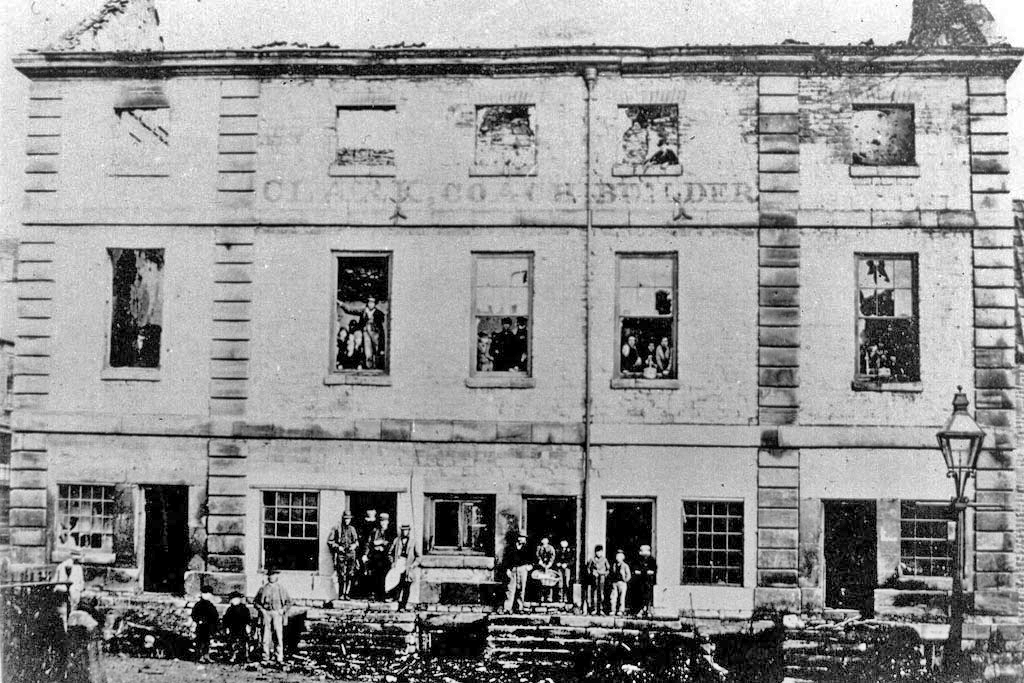
The building which today we call the Memorial Hall was known as the Tollbooth up until 1920. Its name probably originated from the fact that it was owned by the Lord of the Manor and was where the estate would collect “tolls”, such as rent, from its tenants. Another meaning refers to a toll being a place where criminals were kept while awaiting trial and the basement of the building was used as a prison cell before the Police Station in Tinley Garth was built in 1851. It is likely that a building of some sort occupied the site in the Middle Ages after the town was granted its market charter by Henry III in 1254.
In 1740 Thomas Parker, a local historian at that time, tells us that the Tollbooth was rebuilt using stone salvaged from the ruins of the old Neville castle at the top of Castlegate and that it consisted of rooms on four levels. The basement was the prison cell, known as the Hoppit, which was accessed through what we now call the Dugout. The ground floor was used as a market hall with stalls selling local produce such as meat, fruit and vegetables. Above this, the large single room was used as a hall for social events and as a courtroom for the courts which met every two weeks. The uppermost floor contained the workshops and storerooms of tradesmen such as a tinsmith, cabinet maker and cordwainer (shoemaker) and faded printing advertising their presence can still be seen on the exterior of the building. The Tollbooth was the venue for many public gatherings such as a meeting in 1864 to address the problem of the town’s water supply at which it was decided to create a new reservoir and a piped water supply for the town.

In November 1871 a fire broke out in one of the workshops on the top floor and, as the town did not have its own fire appliance, an urgent appeal had to be sent to Helmsley to ask that theirs be sent to help. This arrived two hours later but the horse that was pulling it was so exhausted that it collapsed in front of the Black Swan. By the time a group of men had managed to push the fire engine up the hill to the Tollbooth the fire had burnt its way town to ground level to leave a roofless burnt-out shell.
After the fire the Tollbooth was rebuilt, but without the top floor, and was reopened in 1872. It became the social centre for the town and was used for meetings, exhibitions and dances. One such event was a Grand Ball held in January 1900 which raised £11 5s 0d for the Transvaal War Fund in aid of troops fighting in the Boer War.

The family of local resident Olga Hammond made a donation in her memory, requesting it be used to commemorate a significant event in the town’s history. Local artist Mhairi Maxwell was commissioned to paint a picture of the fire incorporating details from the contemporary account that was later reported in the Gazette & Herald. In 2023 the Kirkbymoorside Hiustory Group held an event at which the painting was unveiled by Mhairi Maxwell and Chris Boddy who was a founder member of the History Group and a long-serving member of Kirkbymoorside Fire Service.

The painting is currently on public display in the Gavel and Bean Cafe on New Road, the A170 to the east of the roundabout.
